Upon my return from leading a group of fifty-four Rotarians and Friends of Rotary, from seven different countries, half-way around the world to India, I was met by a number of friends who asked, “How does it feel to have returned to India on your seventh trip?” “How does it feel to be home?” “How does it feel to travel to and witness what is no less than a paradox in society?” “How does it feel to be a part of Rotary International’s only corporate project – the eradication of polio in the world?” “How does it feel to have left your family, your job, your colleagues, your friends, your community to participate in a nationwide effort, with some 250,000 other volunteers, giving two drops at a time of life-saving polio vaccine, which may save the life of one child?”
Perhaps an underlying question which tacitly lingers just below the surface in the minds of many is, “Why did you do this?”
Nearly eight years ago, my wife, Jane and I traveled to Baltimore, where we attended a leadership conference for Rotarians in the northeastern United States. While there, each of us sat in on general plenary sessions, as well as numerous break-out discussion groups. One in particular remains in my mind, quite vividly. It was a breakfast meeting, sort of a round-table discussion. The topic was “Children at Risk”. The moderator of the session was a friend, G. Holger Hansen, a past District Governor for Rotary, from Pennsylvania. My first impression, when considering the topic, was to think we were going to be talking about youth in our society who are troubled within their families, their schools, their communities, and who unless intervening measures were taken, might well fall into a life of crime. This was not the topic at hand.
“Hogie”, as he was called, told us about a trip he was planning in January 2001, where he and other Rotarians would be traveling to India to participate in a National Immunization Day – where literally millions of children, under the age of five years, would receive polio vaccine, and all in a single day! It was at this point that my mind began to wander a bit. I remembered the mother of one of my father’s secretaries who was confined to an iron lung, to assist her in her breathing, as she was a victim of polio. I remembered a classmate in Portland, who had been stricken with the horror of paralysis and the inability to breathe. I remember the daughter of a friend of my parents who struggled to walk, because she had deformed legs, ankles and feet, and could barely stand without the assistance of a mother’s helping hand or a pair of wooden crutches. I remembered that as kids, we were not allowed to go swimming at the Boys’ Club or the YMCA, or drink from a public water fountain, for fear of contracting polio.
All the way home at the end of that weekend in Baltimore, Jane heard me say many times, “All I want for Christmas is to be able to travel to India to immunize kids against polio!” I told that to Jane, to my mother, to my daughter and son-in-law, and made up my mind that if it were at all possible, that I would be a part of that gathered force to work together to rid the world of polio. Christmas came and my wish came true. My family made it possible for me to purchase the ticket and pay for my hotels and my meals and the folks in my office agreed to cover for me during my two-week absence. To say that I was grateful would be a gross understatement.
As time neared, I asked my colleagues if there was anything in particular they might want me to purchase for them and bring home from India. There were trinkets and jewelry, clothing and carpets, but one request stood prominently before all others. One of the women in my office said, “Elias, don’t bring back anything for me, but sometime on that day, pause for a moment, as you squeeze two drops from the vial of vaccine onto the tongue of one of the children and think of me.” This comment stopped me for a moment and moved me at the same time.
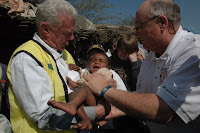
A few weeks later, I was standing in the school yard of one of the grade schools in the oldest section of Delhi, facing dozens of children who were lined up awaiting their vaccine. As each child advanced and announced his or her name, or when a parent of an older sister or brother proudly presented a younger sibling for his or her drops, the exercise of administering the drops of life-saving serum became almost routine, almost monotonous. But something changed. As a young Muslim woman came forward to the head of the line, holding a tiny package in her arms, she looked at me from behind the burkha, which covered all but her eyes, and I guess determined it would be alright for her to entrust her most precious possession – her infant daughter, to me. At that moment, when I squeezed two tiny droplets into the mouth of her baby, I paused and looked up to the sky and thought for a few moments about my friend. My quiet thoughts were shattered by the crying of this tiny baby, who did not particularly care for the flavor of the drops, but who I am sure preferred her mother’s milk. I took a few moments and tried to calm the baby, by humming a soft tune, and when she stopped her crying, I gently passed her back to her mother. The woman, once again, looked at me and simply nodded in silence – a gesture of gratitude. But it was I who was most grateful for the opportunity I had just experienced, of knowing that through the generosity of Rotarians throughout the world, I might have served as the delivery boy for vaccinating this child – that I might have saved this tiny infant from the horrors of this crippling disease.
Seven years later, I still feel an enormous gratitude for the opportunity which first presented itself to me in January 2001. Knowing that somehow I was a part of a greater effort, not only to assist in the immunization of millions of children against polio, but to hopefully contribute to a greater understanding between cultures, which eventually will lead to a lasting peace in this world – for this I feel most grateful, I feel blessed, I feel humbled. Why did I do this? Perhaps the paperweight that sits on my desk, which shares a thought of Mahatma Gandhi, states it best: Be the change you wish to see in the world.
Friday, March 14, 2008

Thursday, March 6, 2008
Pre-NID and NID photos with music (2/9-2/10/08)
Well, this will be a first, if I am successful in adding this 5-minute video to the BLOG. This is a series of photos, taken by several members of the ROTARY DREAM TEAM - INDIA 2008, of the activities for the day prior to the National Immunization Day against polio in India. At the pre-NID rally, we were greeted by the local and regional chief medical examiners, as well as local Rotarians and more than one hundred students from the Rotary Public School in Gurgaon. Together, we marched through Sohna, with loud speakers and banners, announcing the NID for the following day - February 10. We did our best to get out the word and to urge everyone to bring children under the age of five years to receive the polio vaccine from Rotarians and other volunteers.
Hope you are moved by this presentation - made possible by DGE Brad Jett from District 7780.
Hope you are moved by this presentation - made possible by DGE Brad Jett from District 7780.
Wednesday, March 5, 2008
TUESDAY means TURBANS!!! (Feb. 12, 2008)
When we arose this morning, there were a number of things we needed to complete before the end of the day. First of all, the wheelchair and the commode had arrived from Delhi, and several of us were going to be leaving for Nusera to deliver these items. Finishing touches needed to be put on the "work project" in Chahalka village, as we were going to be leaving the following morning for the travel portion of our experience. The unveiling of the total project would take place in mid-afternoon, with a ceremony at the schoolyard adjacent to the training centre and the day-care centre.
The majority of the team members ventured back to Chahalka for completing the work projects and even adding a few more, before we would sign off on our part of the project. Painting was to be completed, both inside and outside the buildings; the mural in the day-care centre was to be completed, including the painting of the floral design created by one of the local schoolgirls - that serving as a border to the mural design (that included, of course, the ROTARY WHEEL!); parts of the wall along the street that bordered the "green space" inside the walls which we had been building for the past several days also required painting. The banner needed to be hung and prominently displayed in front of the training centre. In addition, since there were extra bricks and sand and mortar and crushed stone, a few of the team members, principally Rick Mutchler, determined that if we were to create a "French drain" around the perimeter of the community well, any spillage would simply seep into the ground and be dissipated into the earth or if a great deal of water spilled, it would drain over into the drainage system we had created the previous year. The ditch was dug, then lined with crushed stone and then the sides were faced with bricks and mortar. The new drainage ditch already lessened the amount of standing water which will bring about a total drying of the area, and make it more healthful.
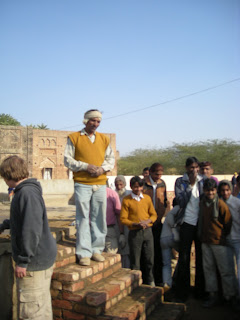 Also, due to the fact of an excess of bricks, Ramish and a few of our team members built not one but two sets of stairs for the women and girls to be able to access the top of the community water supply (the well cover) without having to hoist themselves up and jump down.
  We were able to have one of the panchayat call to a young girl who walked in a stately manner to the bottom of the steps, carrying her water jug on her head, and then climb up the steps! Life in this tiny poor village of Chahalka are slowly improving, provided by the members of the team.

 Also, due to the fact of an excess of bricks, Ramish and a few of our team members built not one but two sets of stairs for the women and girls to be able to access the top of the community water supply (the well cover) without having to hoist themselves up and jump down. We were able to have one of the panchayat call to a young girl who walked in a stately manner to the bottom of the steps, carrying her water jug on her head, and then climb up the steps! Life in this tiny poor village of Chahalka are slowly improving, provided by the members of the team.
Following the "christening" of the new stairs, we then adjourned to the schoolyard, where hundreds and hundreds of grade school children awaited our arrival. The children had been gathered (350 of them with only 3 teachers!) to sit on the ground and attend a very important event. There were two parts to this event - one was the official acknowledgment by the members of the panchayat of the work we had completed to benefit their village. The other was the disposition of thousands of tiny gifts we had all brought with us to pass on to the children of the village. We have been working to try to convince children to remain in school, to convince parents that in the long run, it is better to have their children educated than to let them roam aimlessly through the streets and alleys of the village. We wanted to share this by rewarding those who DO stay in school with recognition of their accomplishments. Each teacher was asked to provide the names and ages of the top three students in his classes, so they could be publicly recognized, not only by us, but in front of their peers, to receive gifts which they could and can use for their education. 
The three teachers for the students in the school maintained a tight reign over their charges, and the old-fashioned stick kept the children in line - at least most of the time.  The ceremony began with the most senior member of the panchayat addressing the crowd, speaking through an antiquated and crackling public address system. He spoke and then Sanjiv translated from Hindi into English, so that the members of our team could understand the comments being made. This gentleman first spoke of how the team from 2007 had come to the village and had rescued the water supply that was deteriorating by the day, through mixture of waste water in with the clean drinking water. The team had come and through the construction of two washing platforms, which had been piped with water, and had proper drainage for the waste water to be eliminated from the area, slowly the drinking water supply cleared itself to a state of safe potability. He was most grateful for this effort.
He went on to talk about the team for this year and how with over fifty people, including several youngsters, we were able to transform derelict buildings into two viable resources for the village - one, a vocational and computer training centre, and the other with the painting of the wonderful mural on the wall, into a day-care centre, where mothers could bring their tiny children and leave them in a safe environment, while they went about their chores or actually enrolled in courses of study to better their own lives, through education.
 Once he had concluded with his remarks, he called his "lieutenant" (also named Elias) to assist him. As the highest sign of respect and honor, the panchayat had decided that each male member of our team should receive a turban, one which was personally tied onto our heads. The fabric used was most colorful, and the process took a few minutes.
 Elias seemed to be very pleased to be able to place a turban on the head of another Elias. The honor was all mine! What a wonderful expression of respect and gratitude shown for all of the members of our team. Each of the women and girls also received an honor - the presentation of colorful scarves to each one, to use for head covering, but more important to remain as a lasting memory of how the people of the village of Chahalka appreciated the efforts made by each of us on their behalf.
  Rotary International Director, Kjell-Ake Akesson and I had the privilege of being seated in a place of honor throughout the ceremonies, and to oversee the passing on of gifts to the children. As mentioned before, the top three students in the classes from several schools which serve the community, received prizes - book bags filled with pens, pencils, writing tablets, crayons, marking pens, and so much more. Our team had taken seriously the charge that they were to bring lots of "goodies' to be given to the children of the village, and my recollection is that if counted individually, we brought some 20,000 items! Obviously, it was impossible to recognize each and every student. One comment that RI Director Akesson made was the observation that in many cases, the top students were the young girls, and it is hoped that by recognizing these girls, the parents and the panchayat will see to it that the girl children will receive the same opportunities as the boys for receiving an education.
 With the turbaning ceremony concluded, the scene turned quickly to chaos, once the magic word CANDY was mentioned. The children literally stormed the front of the venue, reaching out to grab one or two pieces of candy out of the many carton boxes we had brought with us. The smart policy was to have us leave and return to our buses, and to allow the teachers and the members of the panchayat handle the distribution. Walking back to our buses, most of us had mixed feelings about leaving. For most, this was a once-in-a-lifetime experience. For some, we will be returning to Chahalka in the coming year, hopefully with either a Matching Grant or better yet, a 3-H Grant to help fund the construction of sanitary enhancement facilities (toilet blocks) in several locations in the village. There is a desperate need for improvement in sanitation, and we have the capability of raising the necessary funds, as well as the ability to help construct these facilities in the coming year. Bidding farewell to some of the villagers who had made a deep impression upon us, and upon whom some of us had made a lasting impression, was difficult to say the least.
I had boarded the bus, and we were about to leave, when I looked out the window and saw my friend, Ramish the brick mason looking around him with concern on his face. I got off the bus and called to him. When he heard my voice, he came toward me. He extended his hand to me and I took his hand in mine... we shook hands and I noticed his eyes filled with tears. I drew him closer to me and opened my arms to him, whereupon he clung to me, sobbing against my chest. We stood there, still for a few moments, until he had regained his composure, and then I said, "Ramish, it is time for us to leave." He dropped his gaze and then turned and walked away, still with tears streaming down his cheeks. We have promised to return and we will.
We followed this year's theme - Rotary Shares, but more important, we made a positive difference in the lives of the people of Chahalka, by Making Dreams Real! For this, we are most thankful.
Thursday, February 28, 2008
Post-trip Interview - February 25, 2008
A day or two before leaving on this most amazing trip, I was invited to be interviewed on the local FOX NEWS affiliate in Portland, Maine - with connections to WLOB radio (FM 96.3 and AM 1310). Both Ray Richardson and Ted Talbot were very interested in the work we were carrying out - not only with the National Immunization Day against polio (NID) on February 10, but also with respect to the work project we had would undertake in the village of Chahalka. That interview is posted on an earlier entry.
They were gracious enough to invite me to return for an extensive interview following the trip, and I did so on February 25. Click on this link to access that interview:
They were gracious enough to invite me to return for an extensive interview following the trip, and I did so on February 25. Click on this link to access that interview:
http://www.myfoxmaine.com/myfox/pages/ContentDetail?contentId=5628438
We truly appreciate the support we have received from FOX NEWS 23 in Maine, in helping to spread the word throughout southern Maine and New Hampshire with respect to WHO Rotary International is... WHAT Rotary International does... and how together, one tiny step at a time, we WILL eradicate polio from the face of the earth, and also help to achieve a lasting world peace, through greater understanding.
Tuesday, February 26, 2008
The Empty Chair - February 12, 2008
As you have previously read from Mark Brown, on the day of the NID (February 10) several members of our TEAM were dispensing vaccine drops in the village of Nusera - on the outskirts of Sohna. While there, they came across a family, the dad, Zahid Hussin and his wife Hussan Buseri, and their children. They have a fourteen year old son, Igbal Buseri, who has been confined to sitting in a chair - a hard wooden chair, for the better part of his life. He is crippled and paralyzed and sits day after day in his chair. When visiting with the family, members of the TEAM, Jerry and Joanne Larson from Nipigon, Ontario and Tom and Shirley McCaughey from Newfoundland (don't forget the accent is on the last syllable!) spent a good deal of time talking with then, with the help of an interpreter. They looked at this boys contorted body and his withered limbs and learned that he had been in this condition for several years, and the family feared that he had contracted polio. To compound the situation, the same family's youngest child, Sakil Khan (a boy of about two years) had signs that he, too had been stricken with this horrific disease. His tiny leg had withered and simply hung down - lifeless.

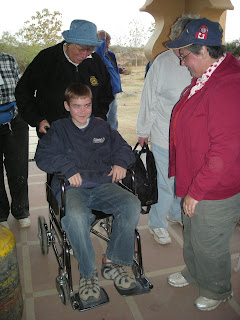 We drove for about an hour to the village and then walked through the streets and alleys to the house. With us was a medical officer from the area, upon we relied to possibly make a positive diagnosis not only for Ikbal, but also his little brother. We included Audrey Athavale in the group to provide interpreter's skills. R I Director Kjell-Ake Akesson also was a part of this group. Naturally, with all of us walking through the streets, we caused quite a stir and again, served as the Pied Pipers of Nusera! We arrived at the home, only to see Igbal sitting in his hard wooden chair in the sunlight. His father was called, as well as his mother (who remained in the shadows with her face covered). It appeared that perhaps Igbal may have recognized Joanne Larson and Shirley McCaughey, who had been with him a couple of days prior. There was a hint of a smile on his face.


As is the nature of Rotarians, the group assured the family that somehow they would see to it that Igbal (the fourteen year old) would have a wheelchair, but more important, the group would also provide him with a commode. You see, when Igbal has to void or move his bowels, he is picked up and carried to the edge of the street where he relieves himself. If nobody is available to assist him, Igbal simply is forced to relieve himself while sitting in the same chair that he calls his "home". We, in western and supposedly more civilized countries, are so blessed and so often take for granted, that we are able to take care of our personal toilet activities, by entering a bathroom, closing the door to provide privacy, and using a flush toilet and being able to wash our hands in a proper sink with running (and safe) water. In this village, as in so many others throughout India (and I might add, in the cities, as well) practice is to go to the curb, relieve oneself and move on. Someone often comes and pushes the excrement into a ditch, which runs along the curb, collecting waste from the general populace, where it flows very often into nearby rivers and streams. A breeding ground for water-borne diseases? You bet!
Well, by the time the group left Igbal and his family, they had promised to look into medical care for the family and the rest of those who live in the village, as well as providing the wheel chair and the commode. Within minutes back on the bus, the TEAM members had already raised the necessary funds to pay for the wheelchair and the commode. Now, it was only arranging for the purchase of these items that stood in the way of the TEAM delivering on their promise!
When we all arrived back at the farm, these folks shared their stories with the rest of us, and we all felt a sense of urgency in making this happen. Sanjiv arranged that someone from the Rotary Club of Delhi-West would purchase the items and get them delivered to the farm within the next 24 hours. Since Jill Wooolacott was to leave the following day, it was arranged that whoever was driving out to the farm to pick her up to take her to the airport to fly back to Australia, would bring the wheelchair and the commode to the farm for us to deliver. As it happened, although there was a huge traffic snarl en route from Delhi to the farm, and Jill (I believe this is correct) had to ride on the back of a motorbike to be taken down to the car that was tied up in traffic - the chair and the commode finally arrived.
On the following morning, Logan Roberts, Cari Roberts, Anna Looby, Sarah and Jake Mutchler and I placed some GOODBYE POLIO... THANKS ROTARY bumper stickers on the metal sides of the wheelchair, while Cari exclaimed, "Now THERE is a pimped out wheelchair!" A group was gathered who would deliver the items to Igbal and his family, and I was privileged to go along on the trip.
We drove for about an hour to the village and then walked through the streets and alleys to the house. With us was a medical officer from the area, upon we relied to possibly make a positive diagnosis not only for Ikbal, but also his little brother. We included Audrey Athavale in the group to provide interpreter's skills. R I Director Kjell-Ake Akesson also was a part of this group. Naturally, with all of us walking through the streets, we caused quite a stir and again, served as the Pied Pipers of Nusera! We arrived at the home, only to see Igbal sitting in his hard wooden chair in the sunlight. His father was called, as well as his mother (who remained in the shadows with her face covered). It appeared that perhaps Igbal may have recognized Joanne Larson and Shirley McCaughey, who had been with him a couple of days prior. There was a hint of a smile on his face.Logan Roberts and Jake Mutchler wheeled the chair and carried the commode to the front and set up both. With some effort, we helped lift Igbal into the wheelchair and to prop him up with a soft hand knit blanket behind his hunched back. Shirley McCaughey had also brought along a new, clean, soft tee-shirt which she was able to pull down over his head and cover his bent body.


The medical officer who had accompanied us examined Igbal and pronounced his diagnosis that this young lad suffered from Muscular Dystrophy, rather than polio. Although this is somewhat a relief, the child's suffering nevertheless rendered him relatively helpless. By providing him a commode, we hopefully restored some of his dignity. By providing him a wheelchair, we gave him mobility and within only a few minutes, Igbal had disappeared, as some of his friends had wheeled him away in his new "chariot" to explore the streets and back alleys of his village - something that he could only have done by being carried by an adult, and which would undoubtedly fall low on the priority list for his family.
With respect to his little brother, Sakil, the medical officer examined him and diagnosed him as a definite victim of polio. HE informed us that custom is to wait for a couple of years before performing any corrective surgery to determine just how debilitating the polio would be on the child. He did, however, assure us that he would personally monitor this case and arrange for regular check-ups and eventual surgery for the child. Additionally, he assured us that he would arrange for more regular visits by a medical officer in the future to this village, to provide well-care and basic treatments for the people of Nusera.
Before leaving, I spoke directly (through the medical officer) to Igbal's father. I said that true to the word of the Rotarians who had visited his home only two days previous, we were good to our word. We had returned and provided his son, Igbal, with a wheelchair and a commode. I said we had met our obligation and our challenge. I then challenged the father to promise that now that his son was "mobile" that he would arrange to have a boy in the village attend to Igbal and to push him to and from school - that he would promise to have his son receive the education provided to all of the village children. The doctor translated for me, and the father paused for a very long time before answering. The doctor informed me that Muslims do not make promises lightly. He went on to explain both to us as well as to the father that when a Muslim man makes a promise, he KEEPS that promise, no matter what. After more thought, the father reached out his hand to me, took my hand in his, and said that he promised that Igbal would receive all the education he could. That one moment was one of the most touching and humbling moments of my life - that this farmer with six or seven children, who barely eeks out a living to provide for his family, who has not one but two of his children who are afflicted with some sort of paralysis, had agreed, had promised to make sure his son would be taken to school. His son, Igbal would no longer be confined to a life in a hard wooden chair. This chair would remain empty!
Monday, February 25, 2008
Some of our team departs - February 11, 2008
Much to our sadness and great loss, several of the team members depart today - from England, Mark Little, Ray Sykes, Chris and Hilary King (she reminded me that she does NOT spell it the way the junior senator from New York does!) and Didier Fosse from France are returning to their homes and back to the normal grind of true Rotarians. To witness this very diverse group of fifty-four people, ranging in age from eleven to seventy-three years, from six countries (and seven if you count Ireland separately from the others in the UK) with differing levels of experience in and with Rotary, and how we all came together, set to work hard the day of the NID, to finally push polio out of India, and then to work at the village of Chahalka in transforming two parts of a large, decaying building into a viable vocational and computer training centre and also a day-care centre, the evolution was absolutely amazing - could this be what I have long termed THE MAGIC OF ROTARY???

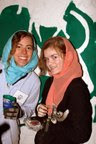
Outside, another totally different mission was not only POSSIBLE, but was being accomplished. Ramish, my friend the brick mason from last year, was leading us all in the creation of a brick wall to surround the yard for both of the centers. The object, according to those who had designed the plan was to enhance the yard area to be one which is special - one which is not only attractive but inviting, and one which when entered would set the students a bit apart from their friends in the village - THEY were taking advantage of a wonderful opportunity, to become trained in computer literacy and to enjoy the chance to perhaps attain an entry-level position with one of the IT companies in nearby Gurgaon. During the week on the job, we must have moved about ten thousand bricks - one at a time, passed by hand from one person on the line to the next. Sometimes, we even realized we had been a bit overzealous, and had to re-pass bricks back to the pile where we had begun. The following photos show the results of our efforts...
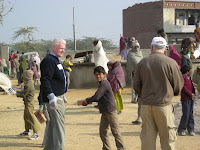
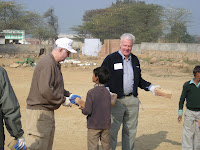

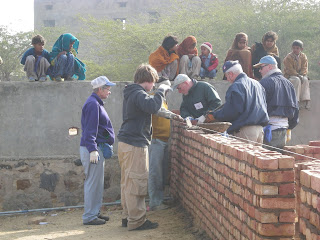 Suffice it to say, that even with the WALL WATCHERS, we accomplished what we set out to do - transform a decrepit building into something for which the villagers can be proud and through the use of which will improve their lives greatly.


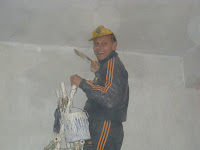
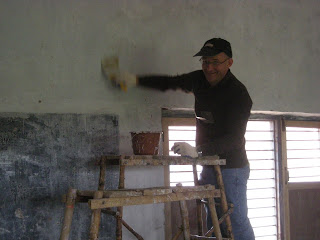
Mark Little was almost immediately up on the ladders, both inside and outside the larger part of the building, slapping paint on the walls, to bring it from a dingy dank set of rooms into an inviting environment.  Didier Fosse and Hilary King were right along with Mark, as well as Liam and Clare Dunne and Audrey and Ann Marie Athavale.
Didier Fosse and Hilary King were right along with Mark, as well as Liam and Clare Dunne and Audrey and Ann Marie Athavale. If you check out this photo, you can see the building (or blank canvas) in the background that would be the focus of our collective attention for the week when we were working there. 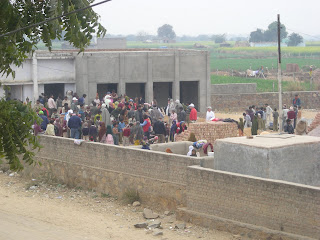
It truly was pretty awful - cold concrete that had not received any prime coat of paint or any attention for several years, and in just a few days, not only were the interior walls and ceilings, doors, trim, windows, etc. all painted several coats of freshening cover, but the exterior was treated in like manner. However, the greatest transformation was what occurred in the other end of the building, where the day-care center is to be located.
Under the guidance of Mark Brown from Newfoundland (accent is on the LAST syllable!) and Ray Sykes from England, a wall was primed and then a mural was first drawn out and then painted by several of the team members. Even some of the local children ventured inside and befriended Cari Roberts and Anna Looby (both from Chaska, Minnesota) who were painting the animals and flowers on the mural. Our hostess, Jyotsna Saran put the finishing touches on the butterfly, and one of the local children actually drew some flowers and leaves to act as a border on either side of the mural.
 You can see from these photos that a tremendous effort was launched and so much appreciated by the other members of the TEAM, but more importantly by the villagers.


Outside, another totally different mission was not only POSSIBLE, but was being accomplished. Ramish, my friend the brick mason from last year, was leading us all in the creation of a brick wall to surround the yard for both of the centers. The object, according to those who had designed the plan was to enhance the yard area to be one which is special - one which is not only attractive but inviting, and one which when entered would set the students a bit apart from their friends in the village - THEY were taking advantage of a wonderful opportunity, to become trained in computer literacy and to enjoy the chance to perhaps attain an entry-level position with one of the IT companies in nearby Gurgaon. During the week on the job, we must have moved about ten thousand bricks - one at a time, passed by hand from one person on the line to the next. Sometimes, we even realized we had been a bit overzealous, and had to re-pass bricks back to the pile where we had begun. The following photos show the results of our efforts...

 Suffice it to say, that even with the WALL WATCHERS, we accomplished what we set out to do - transform a decrepit building into something for which the villagers can be proud and through the use of which will improve their lives greatly.
Later that same day.... February 10, 2008
Following all of the day's activities surrounding the National Immunization Day (NID) we all gathered back in Sohna, near the hospital, and re-boarded our buses to be driven back to Sanjiv and Jyotsna's farm. This is where we had been enjoying all of our meals for the past several days, and would for a few more. Today, at least in the evening, would be an even more exciting event - we would be helping Sanjiv and Jyotsna celebrate their 30th wedding anniversary!!! 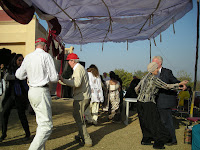

Several of us had agreed to participate in a "talent" show in honor of the "newlyweds" and this was all led by my dear friend, and fellow Rotarian from Norwich, England - Mark Little.

In the past, Mark and his crew have provided limitless entertainment to our groups and this was to be no exception. With the assistance from Ray Sykes, Mark conducted "man in the street" interviews, jokes telling, recitations of various bits of homespun poetry, and then he served as Master of Ceremonies and introduced us to several acts. 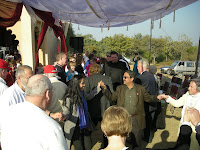 Entertainers included Lynn Freshman, Ken Hiller, Anna Looby, Pallavi Saran-Mathur, Past District Governor Ramesh from the Delhi-West Rotary Club, and several others, including myself. When I was called upon to perform, I requested that everyone in attendance rise and join me in singing the National Anthem of India, and the result was very moving.
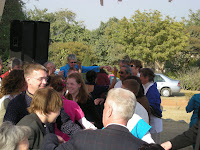 Generally, when one hears the Indian National Anthem, it is not sung with great gusto, but that was NOT the case that evening! Following the "talent", we all enjoyed joining in some dancing, led by the two celebrants, and this went on for nearly a half-hour. We were treated to a wonderful meal, several courses of food prepared by Sandhu and the rest of the crew. Although it was a long day, it was a wonderful way to cap off the day of great accomplishments!
Entertainers included Lynn Freshman, Ken Hiller, Anna Looby, Pallavi Saran-Mathur, Past District Governor Ramesh from the Delhi-West Rotary Club, and several others, including myself. When I was called upon to perform, I requested that everyone in attendance rise and join me in singing the National Anthem of India, and the result was very moving. Generally, when one hears the Indian National Anthem, it is not sung with great gusto, but that was NOT the case that evening! Following the "talent", we all enjoyed joining in some dancing, led by the two celebrants, and this went on for nearly a half-hour. We were treated to a wonderful meal, several courses of food prepared by Sandhu and the rest of the crew. Although it was a long day, it was a wonderful way to cap off the day of great accomplishments!
The previous evening, Pallavi entertained us and held us spellbound while she danced four suites of classical Indian dancing. Hopefully, you will be able to gain some idea as to her performance by clicking on this link: It is a very large file and takes a bit of time to complete the BUFFERING, but be patient and wait til the buffering is completed and then sit back and enjoy the performance!
If viewing that short clip of Pallavi's incredible talent does not intoxicate you with the magic of India, nothing will... She is a gifted young woman who interprets the classical stories and legends of Hindu mythology, and has danced for audiences throughout India, as well as in Maine, New Hampshire, California and at the Nehru Center in London.
Subscribe to:
Comments (Atom)