Tuesday, February 26, 2008

The Empty Chair - February 12, 2008

As you have previously read from Mark Brown, on the day of the NID (February 10) several members of our TEAM were dispensing vaccine drops in the village of Nusera - on the outskirts of Sohna. While there, they came across a family, the dad, Zahid Hussin and his wife Hussan Buseri, and their children. They have a fourteen year old son, Igbal Buseri, who has been confined to sitting in a chair - a hard wooden chair, for the better part of his life. He is crippled and paralyzed and sits day after day in his chair. When visiting with the family, members of the TEAM, Jerry and Joanne Larson from Nipigon, Ontario and Tom and Shirley McCaughey from Newfoundland (don't forget the accent is on the last syllable!) spent a good deal of time talking with then, with the help of an interpreter. They looked at this boys contorted body and his withered limbs and learned that he had been in this condition for several years, and the family feared that he had contracted polio. To compound the situation, the same family's youngest child, Sakil Khan (a boy of about two years) had signs that he, too had been stricken with this horrific disease. His tiny leg had withered and simply hung down - lifeless.


As is the nature of Rotarians, the group assured the family that somehow they would see to it that Igbal (the fourteen year old) would have a wheelchair, but more important, the group would also provide him with a commode. You see, when Igbal has to void or move his bowels, he is picked up and carried to the edge of the street where he relieves himself. If nobody is available to assist him, Igbal simply is forced to relieve himself while sitting in the same chair that he calls his "home". We, in western and supposedly more civilized countries, are so blessed and so often take for granted, that we are able to take care of our personal toilet activities, by entering a bathroom, closing the door to provide privacy, and using a flush toilet and being able to wash our hands in a proper sink with running (and safe) water. In this village, as in so many others throughout India (and I might add, in the cities, as well) practice is to go to the curb, relieve oneself and move on. Someone often comes and pushes the excrement into a ditch, which runs along the curb, collecting waste from the general populace, where it flows very often into nearby rivers and streams. A breeding ground for water-borne diseases? You bet!
Well, by the time the group left Igbal and his family, they had promised to look into medical care for the family and the rest of those who live in the village, as well as providing the wheel chair and the commode. Within minutes back on the bus, the TEAM members had already raised the necessary funds to pay for the wheelchair and the commode. Now, it was only arranging for the purchase of these items that stood in the way of the TEAM delivering on their promise!

When we all arrived back at the farm, these folks shared their stories with the rest of us, and we all felt a sense of urgency in making this happen. Sanjiv arranged that someone from the Rotary Club of Delhi-West would purchase the items and get them delivered to the farm within the next 24 hours. Since Jill Wooolacott was to leave the following day, it was arranged that whoever was driving out to the farm to pick her up to take her to the airport to fly back to Australia, would bring the wheelchair and the commode to the farm for us to deliver. As it happened, although there was a huge traffic snarl en route from Delhi to the farm, and Jill (I believe this is correct) had to ride on the back of a motorbike to be taken down to the car that was tied up in traffic - the chair and the commode finally arrived.

On the following morning, Logan Roberts, Cari Roberts, Anna Looby, Sarah and Jake Mutchler and I placed some GOODBYE POLIO... THANKS ROTARY bumper stickers on the metal sides of the wheelchair, while Cari exclaimed, "Now THERE is a pimped out wheelchair!" A group was gathered who would deliver the items to Igbal and his family, and I was privileged to go along on the trip.
We drove for about an hour to the village and then walked through the streets and alleys to the house. With us was a medical officer from the area, upon we relied to possibly make a positive diagnosis not only for Ikbal, but also his little brother. We included Audrey Athavale in the group to provide interpreter's skills. R I Director Kjell-Ake Akesson also was a part of this group. Naturally, with all of us walking through the streets, we caused quite a stir and again, served as the Pied Pipers of Nusera! We arrived at the home, only to see Igbal sitting in his hard wooden chair in the sunlight. His father was called, as well as his mother (who remained in the shadows with her face covered). It appeared that perhaps Igbal may have recognized Joanne Larson and Shirley McCaughey, who had been with him a couple of days prior. There was a hint of a smile on his face.

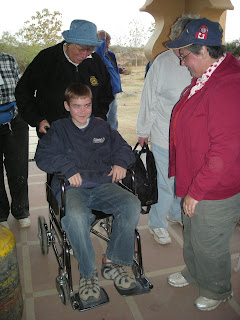
Logan Roberts and Jake Mutchler wheeled the chair and carried the commode to the front and set up both. With some effort, we helped lift Igbal into the wheelchair and to prop him up with a soft hand knit blanket behind his hunched back. Shirley McCaughey had also brought along a new, clean, soft tee-shirt which she was able to pull down over his head and cover his bent body.


The medical officer who had accompanied us examined Igbal and pronounced his diagnosis that this young lad suffered from Muscular Dystrophy, rather than polio. Although this is somewhat a relief, the child's suffering nevertheless rendered him relatively helpless. By providing him a commode, we hopefully restored some of his dignity. By providing him a wheelchair, we gave him mobility and within only a few minutes, Igbal had disappeared, as some of his friends had wheeled him away in his new "chariot" to explore the streets and back alleys of his village - something that he could only have done by being carried by an adult, and which would undoubtedly fall low on the priority list for his family.


With respect to his little brother, Sakil, the medical officer examined him and diagnosed him as a definite victim of polio. HE informed us that custom is to wait for a couple of years before performing any corrective surgery to determine just how debilitating the polio would be on the child. He did, however, assure us that he would personally monitor this case and arrange for regular check-ups and eventual surgery for the child. Additionally, he assured us that he would arrange for more regular visits by a medical officer in the future to this village, to provide well-care and basic treatments for the people of Nusera.


Before leaving, I spoke directly (through the medical officer) to Igbal's father. I said that true to the word of the Rotarians who had visited his home only two days previous, we were good to our word. We had returned and provided his son, Igbal, with a wheelchair and a commode. I said we had met our obligation and our challenge. I then challenged the father to promise that now that his son was "mobile" that he would arrange to have a boy in the village attend to Igbal and to push him to and from school - that he would promise to have his son receive the education provided to all of the village children. The doctor translated for me, and the father paused for a very long time before answering. The doctor informed me that Muslims do not make promises lightly. He went on to explain both to us as well as to the father that when a Muslim man makes a promise, he KEEPS that promise, no matter what. After more thought, the father reached out his hand to me, took my hand in his, and said that he promised that Igbal would receive all the education he could. That one moment was one of the most touching and humbling moments of my life - that this farmer with six or seven children, who barely eeks out a living to provide for his family, who has not one but two of his children who are afflicted with some sort of paralysis, had agreed, had promised to make sure his son would be taken to school. His son, Igbal would no longer be confined to a life in a hard wooden chair. This chair would remain empty!


Monday, February 25, 2008

Some of our team departs - February 11, 2008

Much to our sadness and great loss, several of the team members depart today - from England, Mark Little, Ray Sykes, Chris and Hilary King (she reminded me that she does NOT spell it the way the junior senator from New York does!) and Didier Fosse from France are returning to their homes and back to the normal grind of true Rotarians. To witness this very diverse group of fifty-four people, ranging in age from eleven to seventy-three years, from six countries (and seven if you count Ireland separately from the others in the UK) with differing levels of experience in and with Rotary, and how we all came together, set to work hard the day of the NID, to finally push polio out of India, and then to work at the village of Chahalka in transforming two parts of a large, decaying building into a viable vocational and computer training centre and also a day-care centre, the evolution was absolutely amazing - could this be what I have long termed THE MAGIC OF ROTARY???


Mark Little was almost immediately up on the ladders, both inside and outside the larger part of the building, slapping paint on the walls, to bring it from a dingy dank set of rooms into an inviting environment. Didier Fosse and Hilary King were right along with Mark, as well as Liam and Clare Dunne and Audrey and Ann Marie Athavale.
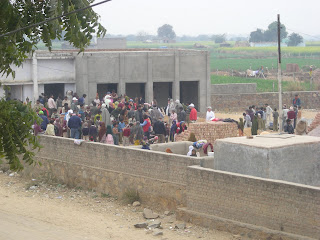
If you check out this photo, you can see the building (or blank canvas) in the background that would be the focus of our collective attention for the week when we were working there.

It truly was pretty awful - cold concrete that had not received any prime coat of paint or any attention for several years, and in just a few days, not only were the interior walls and ceilings, doors, trim, windows, etc. all painted several coats of freshening cover, but the exterior was treated in like manner. However, the greatest transformation was what occurred in the other end of the building, where the day-care center is to be located.

Under the guidance of Mark Brown from Newfoundland (accent is on the LAST syllable!) and Ray Sykes from England, a wall was primed and then a mural was first drawn out and then painted by several of the team members. Even some of the local children ventured inside and befriended Cari Roberts and Anna Looby (both from Chaska, Minnesota) who were painting the animals and flowers on the mural. Our hostess, Jyotsna Saran put the finishing touches on the butterfly, and one of the local children actually drew some flowers and leaves to act as a border on either side of the mural.

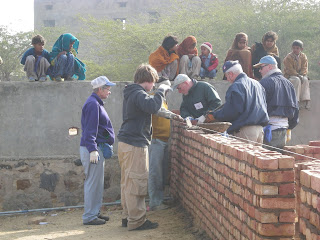
You can see from these photos that a tremendous effort was launched and so much appreciated by the other members of the TEAM, but more importantly by the villagers.


Outside, another totally different mission was not only POSSIBLE, but was being accomplished. Ramish, my friend the brick mason from last year, was leading us all in the creation of a brick wall to surround the yard for both of the centers. The object, according to those who had designed the plan was to enhance the yard area to be one which is special - one which is not only attractive but inviting, and one which when entered would set the students a bit apart from their friends in the village - THEY were taking advantage of a wonderful opportunity, to become trained in computer literacy and to enjoy the chance to perhaps attain an entry-level position with one of the IT companies in nearby Gurgaon. During the week on the job, we must have moved about ten thousand bricks - one at a time, passed by hand from one person on the line to the next. Sometimes, we even realized we had been a bit overzealous, and had to re-pass bricks back to the pile where we had begun. The following photos show the results of our efforts...


Suffice it to say, that even with the WALL WATCHERS, we accomplished what we set out to do - transform a decrepit building into something for which the villagers can be proud and through the use of which will improve their lives greatly.


Later that same day.... February 10, 2008

Following all of the day's activities surrounding the National Immunization Day (NID) we all gathered back in Sohna, near the hospital, and re-boarded our buses to be driven back to Sanjiv and Jyotsna's farm. This is where we had been enjoying all of our meals for the past several days, and would for a few more. Today, at least in the evening, would be an even more exciting event - we would be helping Sanjiv and Jyotsna celebrate their 30th wedding anniversary!!!
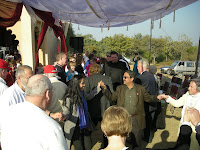
Several of us had agreed to participate in a "talent" show in honor of the "newlyweds" and this was all led by my dear friend, and fellow Rotarian from Norwich, England - Mark Little.
In the past, Mark and his crew have provided limitless entertainment to our groups and this was to be no exception. With the assistance from Ray Sykes, Mark conducted "man in the street" interviews, jokes telling, recitations of various bits of homespun poetry, and then he served as Master of Ceremonies and introduced us to several acts. Entertainers included Lynn Freshman, Ken Hiller, Anna Looby, Pallavi Saran-Mathur, Past District Governor Ramesh from the Delhi-West Rotary Club, and several others, including myself. When I was called upon to perform, I requested that everyone in attendance rise and join me in singing the National Anthem of India, and the result was very moving. Generally, when one hears the Indian National Anthem, it is not sung with great gusto, but that was NOT the case that evening! Following the "talent", we all enjoyed joining in some dancing, led by the two celebrants, and this went on for nearly a half-hour. We were treated to a wonderful meal, several courses of food prepared by Sandhu and the rest of the crew. Although it was a long day, it was a wonderful way to cap off the day of great accomplishments!


The previous evening, Pallavi entertained us and held us spellbound while she danced four suites of classical Indian dancing. Hopefully, you will be able to gain some idea as to her performance by clicking on this link: It is a very large file and takes a bit of time to complete the BUFFERING, but be patient and wait til the buffering is completed and then sit back and enjoy the performance!

If viewing that short clip of Pallavi's incredible talent does not intoxicate you with the magic of India, nothing will... She is a gifted young woman who interprets the classical stories and legends of Hindu mythology, and has danced for audiences throughout India, as well as in Maine, New Hampshire, California and at the Nehru Center in London.


Friday, February 22, 2008

TODAY’S THE DAY!!!

Up bright and early, and down to our respective hotel dining rooms to enjoy breakfast before setting out in the buses to go back down into Sohna to the central location from where we would disburse to various locations throughout the area. We were dropped off from the buses and then walked through streets and alleyways until we reached the area where local officials, including the district collector and what would be referred to as the town council had gathered to await the arrival of our team. Our presence and participation in this N.I.D. could be considered “huge” by the locals. Imagine that over fifty people from six countries had left their homes and families to travel at their own expense, to join hundreds of thousands of other volunteers to provide drops of oral polio vaccine to well over one hundred and fifty million children, and all in one day!


I was introduced to the district collector and together, he and I cut the ribbon to officially open that distribution center. I was then invited to go inside a reception area, where we were to discuss the local efforts and how measures could improve. I had been requested to be rather stern with him and the rest of the council members, as there had been a few cases of polio diagnosed within the last twelve months, and there is a great concern that pockets of population, especially in Uttar Pradesh, were in danger of showing new cases of polio. Actually, in January of this year, one little boy of about fifteen months had been diagnosed as having polio.

After reviewing the policy of the village council, and the program to make sure all children were reached and vaccinated, it seemed to me that my expression of concern was not reaching the district collector and the members of the council. Finally, while sitting there, I happened to think of my six-year old grandson, “J.T.” I asked if the district collector had any children. He told me he had two young boys. I expressed my concern that with only one or two plane trips, children from this area could travel to countries which had been polio-free for decades and bring with them the virus to infect children who had not yet been immunized. Without appearing to be too critical, I assured the district collector that I would personally hold him responsible if any children were to be diagnosed with polio in our country. I encouraged him to enlist the help of whatever number of volunteers he needed to get the job done – to finally eliminate polio from the area. He agreed with what I described as my concerns and consulted with the other members of the village council attending this meeting and together they reassured me that they would do “whatever it takes!” I thanked all of them for their understanding of the gravity of the situation and their promises to take the steps necessary to ensure that all children would be immunized and, further that their villages would be polio-free in 2008 and beyond.

Once we had concluded our meeting, and shared tea and snacks (there is almost always tea served) we disbursed into several small groups throughout that village, and several of us walked quite a distance to various distribution centers, where we dispensed the polio vaccine drops to the children under the age of five years who lived in the various neighborhoods. Along with us was a young girl – a Muslim, of about seventeen years. She was a member of the Interact Club in her town, and served as our translator. In addition, her father was with us and directed us to the various locations where the polio vaccine would be made available to the local children. We walked briskly from place to place, undeterred by the occasional water buffalo wandering aimlessly in the alleys, or the children who were playing marbles or the several youngsters who were relieving themselves on the side of the alleys. We eventually reached the girl’s village and again, wended our way through the narrow alleys (almost pathways) to the distribution centers. We even climbed a few flights of stairs to reach some of the “roof-top” distribution centers. There were always local men and women volunteers who were dispensing the vaccine, but they were so pleased to have us arrive and to assist them – giving the drops, marking the tiny fingers of those children who had received them with a purple marker (much the same as what was used in Iraq, following the free elections there) and moving onto the next child. The tiniest of infants up to children of five years were brought to the distribution centers by sisters, brothers, mothers, fathers and grandparents.

At one point, we had finished our work and walked out into the commercial area of the town, on a main thoroughfare. We located yet another booth where drops of vaccine were being dispensed and so we stopped to lend a hand. The young man at the booth indicated they had not been very busy. Well, Jill Woolacott (a tiny lady from Australia who was a part of our TEAM) was not about to let that situation continue. Each time she saw a woman walking by, carrying a tiny child, Jill took it upon herself to go out into the street, call to the woman and ask that she come back to have her baby vaccinated! Now THIS is ROTARY IN ACTION! Some of the other folks in the group joined Jill in her efforts to attract more “business” and pursued some people quite a distance before getting them to turn around and return to the distribution booth to have their children receive the drops of life. We were undaunted in our efforts. One of the village council members had joined us in the first half-dozen booths we visited. When it was time to move on to other locations, he arranged for two vehicles to pick us up and drive us there, since it would be a few kilometers away from where we were at the time.

Once we had visited all of the booths in our area, we were invited by our young Interact translator to join her and her father at their home in the village for some (you guessed it) tea and snacks! We were welcomed into their home and sat looking at the many Muslim characters painted on canvas and carved into leather framed and hanging above the doors into the living quarters. We had a delightful visit with them, learning that the girl was pursuing pre-medical examinations for college and that she wished to remain in India for her education and to return to her village to treat those with medical needs in the future.

We parted company with the father, and the young girl accompanied us back to the village, where we were to meet with all of the other members of our team who had traveled about a half-hour from the place we had all begun. When we arrived back in town, the buses were waiting, and several members of our team were being interviewed by local radio and television stations. One of them introduced me as the team leader, and I was also interviewed. We boarded our buses and drove back to Sanjiv’s farm, where we were to spend the late afternoon and evening, helping Sanjiv and Jyotsna celebrate their 30th wedding anniversary, along with several members of the Rotary Club of Delhi-West, and other friends. Up to now, it HAD been a very good day!

PRE-N.I.D. RALLY IN SOHNA

Following lunch at Sanjiv’s farm, we boarded the six buses, now displaying special banners created for our ROTARY DREAM TEAM – INDIA 2008, showing the Rotary Wheel, this year’s theme – ROTARY SHARES, along with the flags of the six nations (plus India) participating in this year’s work project – Canada, England, France, Australia, Sweden, the United States and India. We drove out of the farm area, and turned onto the serpent-like road, which we would descend following dozens of heavy-duty trucks, donkey carts, motorcycles, cars – you name it! We were on our way to join others at the local medical center to kick off the rally to raise the awareness about the National Immunization Day (N.I.D.) which was scheduled for the following morning.

When we arrived at the hospital, we were welcomed by a number of dignitaries, including the chief medical officer of the entire area. He had visited the farm the previous evening to share with us the latest statistics regarding polio in India and the world.
This gentleman is a functionary of the World Health Organization, with whom Rotary and the local governments cooperate in our efforts to eradicate polio from the world. We all sat for the opening ceremony (and did I say that NOBODY does ceremony like they are done in India???) and were officially greeted by the Chief Medical Officer and Rotarians from Gurgaon – a city of approximately 1.2 million, which has four Rotary Clubs and is the closest area where there are Rotary Clubs. Many were presented with bouquets of flowers – another Indian tradition, and several, including myself, were invited to address the gathering.

Joining us for this rally were about one hundred students from the ROTARY INTERNATIONAL SCHOOL OF GURGAON, who were dressed in their uniforms, and wearing yellow POLIO PLUS baseball-type caps, emblazoned with the Rotary emblem. I had the pleasure of visiting this school five years ago, and was so impressed by the students, as well as the fact that approximately one-half of the students come from families living way below the poverty level, but who are able to attend the school because of the generosity of Rotarians in the area who have established a substantial scholarship program. In addition, a relatively high percentage of students are victims of polio, being forced to get around in wheelchairs or by using crutches. Some of the students carried banners announcing the N.I.D. on the 10th, and all displayed an incredible level of enthusiasm for the rally.

Once the speeches were concluded, we gathered at the gate to the hospital and proceeded to march along behind the students for a few kilometers around Sohna. I was pleased to see that a few of the Rotarians from the Delhi-West Club had made the effort to drive the two hours from the city out to Sohna to meet our team and to be a part of the pre-N.I.D. rally. One of those Rotarians is a victim of polio and each year he heartily endorses the efforts of fellow club members and of Rotary International, by participating in the N.I.D. programs every time.

We marched along the streets of Sohna, waving at the children and the shopkeepers, dodging puddles in our way, as well as the occasional “deposit” left by the cows and the water buffaloes, who roam the streets foraging for hay or straw or any other morsels they can find. The entire “march” lasted about an hour, and we returned to the buses to travel back up “Switch-back Mountain” to the farm.

We enjoyed another fine selection of local dishes at dinner and listened to Sanjiv while he described the activities for the next morning – the National Immunization Day. Our team, along with probably two hundred thousand other volunteers and paid medical staffers throughout the country would all work together to make sure the children under the age of five would receive their “Drops of Life” before the end of the day.

Not only would the sun come out tomorrow, but also it would be a VERY GOOD DAY. We would each have the opportunity to place two drops of vaccine on the tongues of children, ensuring that at least THEY would be saved from the crippling, debilitating ravages of polio.

WORK, WALK-ABOUT & WAGERS…

Breakfast was prepared at the farm, placed into thermal packs and then delivered to us on the buses, along with water and apple juice. It consisted of rotis (the flat bread cooked by our Sandu and Rajendra and the rest of the staff brought on by Sanjiv, especially for preparing the meals for our group. It was tasty, quick and we were able to finish it in order to maximize the time we could work on the projects we had begun the previous day.


Some of us set out to work on the walls, some painting the exterior of the soon-to-be computer and vocational training center, others worked on the mural, others passing bricks our to the street area where the watering trough was well underway. Tom Hanna, Chris King, Don MacGarry, Peter Ivy and a few others chose to take on this project as their own. The group created quite a spectacle for the men who sat on litter-type beds and smoked their hookahs, as they basked in the sun and “observed”. “It’s a cultural thing, and we should not let it bother us”. It is our hope that eventually men, women and children will take enough interest in what we are doing to actually offer to lend a helping hand, rather than to be the official sidewalk observers, and Saturday morning quarterbacks!

Kjell-Ake was pleased for me to take him around the entire site, seeing what we had accomplished with our small but devoted team of 2007, but then, he immediately joined the brick line, passing several hundred bricks along to those working outside the wall. It did not take too long before Judith Reardon (our official cheer-leading, HIGH-FIVE GORGEOUS GRANDMA) had cajoled some of the young boys and teenagers to join in the brick line, and it was good to see that Kjell-Ake had one young lad on each side of him, passing on the bricks. Mark Little from Norwich, England and Audrey Athavale, joined by Liam Dunne teetered on bamboo ladders up against the outside walls, wielding their paintbrushes and rollers (many of which were brought to our project by Mark Little and Susan Wischhusen) to bathe the exterior in a warm yellow-orange finish. The outside areas, where we were building the walls, is to be landscaped and made a special “green” area, where upon entering, the students, as well as the tiny tots, will be able to experience something very special – again boosting their morale and self-esteem and possibly acting as an encouragement to remain in school and to strive to take classes in this training center or to have the mothers of tiny children to bring them to the day-care center where they will enjoy tender, loving care. In the meanwhile, the moms will be able to learn stitchery, weaving and cosmetology, thereby being able to augment the family income. Little by little, our team seems to be making connections with the villagers, and when some have wanted to take a break from their labor, a few at a time have wandered up the main street (?) of Chahalka, stopping at the local tailor shop – the young man has a treadle sewing machine, a few bolts of cloth, but from those basics is able to stitch just about anything from the traditional salwar kameez to a proper dress shirt for men. Next to the tailor’s shop is another gentleman who sells table cloths and head coverings. On the other side of the tailor shop is the local medical dispensary, which is tended to by someone who comes by twice each week, and then is visited by a physician once a week. Upstairs over the dispensary, three of us climbed very steep and uneven stairs, to get to another shop – more of a storage room for one of the other shops below, where we found some scarves to purchase. I noticed a young woman - possibly a girl of fifteen or sixteen, who was nursing her baby. She sat serenely on a bed, her head covering lightly draped over her shoulder and just covering the baby’s face. She seemed oblivious to the bit of commotion we caused by invading her private space and the shop of her family. The baby had fallen asleep and she passed him on to one of her younger sisters. I walked out onto the balcony of this room, and had a bird’s eye view of our project below and across the road. Carefully draped over the railing of the balcony was a POLIO PLUS banner, announcing the National Immunization Day scheduled for February 10th.

We departed this shop and descended the stairs, where the shopkeeper on the other side of the tailor’s space (these are all ten feet by fifteen feet in size) had been found and had opened his shop. I had purchased a woven square cloth the previous year (white with red design) and was looking to purchase another similar cloth this year. Last year, two of the men had attempted to instruct me in the way to create a headdress from the cloth, but I had failed miserably. I was hoping for another more successful attempt this year. He showed me cloth after cloth, each time taking one down from a rudimentary clothing rack, created by suspending a bamboo stick from two pieces of twine from eye bolts in the ceiling, then displaying his wares from hangars hooked over this bamboo pole. One after another was NOT what I was hoping to find. One of the ladies who was walking along with me – Aruna Khoushik, is a native of India, now living in Ontario, and she was very helpful by providing interpretation and translation between the shopkeeper and me. I described the cloth as one similar to what Yassar Arafat often wore as a head covering. Ahhhhhhhhh…. Now he understood. Just as he was looking, I spied what appeared to be a similar cloth, only woven in green rather than red. When I pointed it out to the shopkeeper, he smiled, took it down from the hangar and shook it with a snap or two, creating a dust cloud which would put the cartoon character Pigpen from Charlie Brown to shame! We haggled over the price for a few minutes, with me telling him that I had paid seventy-five rupees for the red and white cloth the year before, while he wanted two hundred rupees. Finally, he looked as if he actually may have recognized me or remembered my purchase from the previous year. He said to Aruna in Hindi, “He paid seventy-five rupees last year because he purchased THREE such cloths and I gave him a discount!” He HAD remembered. We “discussed” price for a few more minutes and finally settled on the seventy-five rupees. Such a bargain!

From that shop, we wandered up the road and at the top of the hill was a man about twenty-five years of age, tending to his cart with a stack of egg crates (each holding three dozen eggs) and perhaps eight layers high. He was cooking an omelet and we stopped to watch him. He had chopped up some red onion, cilantro, green peppers and some chili peppers, and stirred that into the egg mixture. He was cooking in an iron skillet over a flame produced by a sort of camp-stove contraption, fueled by bottled propane. The omelet appeared to be half-cooked, when he placed two pieces of toasted bread into the middle of the pan, allowing the concoction to fry a bit longer, and then he folded each side in toward the center, folded the entire thing in half creating what he called “omelet sandwich”. If I had not recently eaten my lunch, I would have been happy to purchase one of these sandwiches.

We walked further along, peeking inside the open entrances of the various homes, watching the tiny children who were either playing in the street – some pushing tiny carts on long sticks, crashing them into one another, as all kids will do. Add to that the sheer fascination and amazement with us, exhibited on the faces of women and children (the men were all down at the work site, sitting on the wall and observing us) and we almost created a parade, with me leading the group as the Pied Piper of Chahalka!

After about an hour, we returned back to the work site to pass more bricks in the brick line and to work on building the wall around the outside of the training center and the day-care center. The team worked for the remainder of the morning and piled back onto the six small buses for a ride back to Sanjiv’s farm for lunch. Overall, we had accomplished a substantial amount of work – raising the wall several score of bricks, establishing better relations with some of the villagers, and contributing a bit to the local economy.

Thursday, February 14, 2008

FIRST FULL DAY OF WORK @ CHAHALKA - February 8, 2008

Not necessarily bright-eyed and bushy-tailed, we strolled to our buses and boarded them. Some had slept soundly, most slept intermittently, while others did not sleep at all. We were met by our buses (our driver is Ajit) and driven back to the farm for breakfast before going to the village to being our work project. It was still VERY cold in the morning, but we shivered through breakfast in the outdoor breakfast tent erected just for our group’s meals. We once more boarded the buses and were driven through the back paths and over the craggy terrain to Chahalka. None of the other members of the team had been with me the prior year when we funded and constructed two washing platforms for the women and girls to wash their linens, clothes, dishes and water buffalos at the central well. How gratifying it was for me to see that all of them were using the washing platforms, rather than the well cover as they had in the past – thereby polluting their own drinking water supply. It seemed that some of the villagers actually recognized me and came to greet our team. We were divided up into groups – some for painting and others four outside construction and masonry.

The previous year, I worked closely with the local brick mason, Ramish, and he seemed genuinely pleased to see me again, and smiled as he embraced me with a strong hug. Last year, it took about two-and-a-half days for Ramish to invite me to place bricks on the wall we were building, but this year, it was only five minutes before he almost implored me to get to work and start laying bricks. As time passed through the morning, it was not long before Ramish trusted me with using the plumb line to make sure the corners were properly in plumb – front, side and back. This is no small accomplishment, since there is absolutely no consistency or regularity among the bricks. Mortar or masala as the Indians call it, was mixed by two local boys, with reasonable consistency, and everything done using spades and hoes, cutting into the pile of sand with a bag of cement mix dumped on the top of the cone, a hole hollowed out where the water was poured and then mixed. Basin after basin of the masala was carried over by our crew to me, I placed it near Ramish for him to trowel onto the top of the scores of bricks, to lay yet another layer. In the meanwhile, many others went inside the two buildings to paint the walls with a primer coat, in order to prepare for the final colors to be applied. Ceilings, window casings, doors and window frames – all were painted. On the side where the day-care center was to be built, Mark Brown, Ray Sykes and several others worked to draw out the mural pattern of a hillside covered with many different animals, and a sea with whales. Some of the local children joined them by sketching many beautiful flowers and vines on both sides of the mural. The other walls will be painted a solid color, so the tiny young children can really focus on the exciting animals that would now be painted by our team members, including Anna Looby and Cari Roberts from Chaska, Minnesota.

Meanwhile, back at the ranch… (I can’t believe I said that!) several of the team members were gathered in what used to be the dining room at the farm, transforming the space into a ROTARY DEPARTMENT STORE! Our team members had collected and brought literally close to 20,000 gift items, ranging from pencils, bracelets, yo-yos, whistles, Beanie Babies, other stuffed animals, bottles of bubbles, pens, solar calculators, tennis balls, footballs (official kicking balls from the Minnesota Vikings), Frisbees (tiny and regulation size) stickers, soccer balls, baseballs, baseball bats, plastic farm animals and dinosaurs, pens and stickers from various states, pads of paper, computer software programs, coloring books, crayons, canvas tote bags, and did I mention the kitchen sink??? It took nearly two full days for sorting through all of the gifts in order to provide equality for all of the recipients – whether they be teachers to pass on to students who excel or are with special needs, or to the village children. OOPS, I nearly forgot the two bushels of lollipops! The families will probably never forgive us for providing sugar highs to their children (we decided to give those out on the last day, as we are driving on to our next destination!). Tom McCaughey from Newfoundland oversaw this effort, and the sorting group consisted of Kelly Wike, Shirley McCaughey, Karen Teichman and Sarah Mutchler (who brought a youthful perspective to the effort). If I have inadvertently omitted anyone, I apologize.

Back to the farm for lunch and then returning to the work site, we continued to work on well into the afternoon, successfully completing two sections of brick wall, digging out of an area outside the playground wall to creating a footing for construction of a watering trough for the water buffaloes – during drought season, they need water and have up until now entering the playground and drinking from pails of water at the well site, all the while relieving themselves thereby having their waste seep down into the well and polluting the drinking water supply. We had just been successful in the past year of building the washing platforms for the ladies and girls so they would no longer find it necessary to wash dishes and clothes on top of the well and letting their waste water run back into the well.

When we had completed our workday, we returned to the farm for drinks and dinner, and awaited the arrival of my friend, RI Director Kjell-Ake Akesson from Sweden, who had been appointed as the official representative of Rotary and the Rotary Foundation by TRF Chair Bob Scott. Kjell-Ake had been two days in meetings and was anxious to meet his fellow teammates. In addition we were also waiting for the arrival of the Chief Medical Officer for the World Health Organization who oversees the polio eradication effort in this part of India, who would address us about concerns he has for the current conditions and outbreaks of polio in the nearby areas. The area where we are working is very close to Uttar Pradesh, which is one of the sections of India where polio remains endemic. It seems that in many instances the children who are being diagnosed with or are suspected of having contracted polio are Muslims – still the myth exists that the polio eradication program is sterilizing the children, rather than saving them from the ravages of paralysis by polio. Many of the Muslim girl children are immunized, while ignoring the boy children, in the belief that they would be rendered impotent. In years past, it has been through the intervention of Rotary and its members to convey to the imams of the Muslims in India that we are here to immunize and thereby, save their children, rather than sterilizing them. However, the message is not being transmitted into the tiny hamlets or enclaves of Muslims as effectively as we would like.

Being tired (over-tired) and cold and hungry, I am afraid that we may not have presented the best face for the chief medical officer or even the RI Director, upon their arrival, but we were presented with a slide presentation of current conditions in the area, and then treated to another sumptuous dinner. One of the aspects of traveling, particularly in India, is for us westerners to understand and respect the difference in cultural practices – dinner is NOT at 6:00 p.m., but rather extends well into the night and may not even be served until 10:00 p.m. It is not for us to impose our practices on our hosts, but rather for us to adapt as guests of their hospitality and their culture. Slowly, we are getting to that point.

With dinner concluded, we were back in the buses heading for what perhaps might be the first night of chilly but possibly uninterrupted sleep, to have breakfast on Saturday morning prepared at the farm but then delivered to the buses for our consumption and enjoyment. In this way, we would be able to maximize our time working at the site. Although some of our rooms were provided with portable heaters, others had none. Some rooms had showers, others were provided with a large bucket to collect warmish water and then to use the small pitcher to drizzle water over our bodies, soap up and then rinse – for some, their first encounter with BUCKET BATHS.

There was morning and there was evening – the FIRST day, and we saw that it was good.